

Every single day, sunglasses are doing a lot more work than they get credit for. They’re protecting your eyes, shielding your skin, cutting glare, and often pulling together your entire look.
But even the best-looking pair in the world will fall short if the fit is wrong. If your sunglasses slide down your nose, pinch your temples, sit crooked on your face, or leave marks that linger long after you take them off, something’s not quite right. And no, that discomfort isn’t normal.
A good fit is the difference between sunglasses you tolerate and sunglasses you forget you’re wearing.
So how should they fit? Face shape plays a role, sure, but comfort, coverage, stability, and sizing matter just as much
The Quick-Hit Fit Checklist
If you just need a simple checklist to make sure your glasses are fitting correctly, this one should do the trick. Want a little more detail? Just keep scrolling and we’ll share everything we know.
Sunglasses that fit properly should:
- Sit just below your eyebrows with your eyes centered in the lenses
- Never touch your cheeks, even when you smile
- Feel secure on your temples without squeezing your head
- Leave no deep nose marks after short wear
- Stay put when you look down, turn your head, or move around
If they’re failing at more than one of these, your sunglasses are trying to tell you something’s wrong.
How to Choose Sunglasses That Actually Fit
Do I like how these look on me?
Do they make me feel cool?
Fair questions, sure. But fit deserves just as much attention.
Sunglasses should rest comfortably across your nose and hook securely behind your ears. They should feel balanced, not front-heavy. You shouldn’t be adjusting them every few minutes or being hit with a tension headache in the middle of your day.
If you notice pressure along your temples, the frame is likely too narrow. If the bridge of your nose has deep welts stamped into your skin, the fit or sizing is off.
And one important reminder: pain, pressure, and headaches are not normal sensations that should accompany your sunglasses. These are signs that you’ve got the wrong size or shape for your face and probably need to switch it up.
The Perfect Fit Matters More Than You Think
Wearing sunglasses that don’t fit properly comes with a few undesirable consequences.
They get annoying fast
Too tight and they squeeze sensitive areas like your temples and nose. Too loose and they slide, bounce, and drive you nuts.
They protect less than you think
Even lenses with full UV protection can’t do their job if light is leaking in from the sides or over the top. Gaps will cancel out good coverage.
They don’t do your outfit any favors
Sunglasses are still a style statement. Frames that are too big, too small, or crooked can throw off your whole vibe.
Fit Problems and How to Fix Them
If your sunglasses don’t feel right, the issue usually falls into one of these categories.
Sunglasses Sliding Down Your Nose
What’s happening: The bridge is too wide, the lenses are heavy, or the temples are not adjusted.
What helps: Minor temple adjustments may work. If they still slide, the size or bridge width is likely wrong.
Pinching at the Temples
What’s happening: The frame is too narrow for your face.
What helps: Small adjustments can relieve pressure, but ongoing pinching usually means you need a wider frame.
Deep Nose Marks
What’s happening: Poor pressure distribution or an ill-fitting bridge.
What helps: Adjustments to the nose pads can help, but if marks keep showing up, the bridge size is not right for you.
Crooked or Uneven Fit
What’s happening: Uneven temples or loose screws.
What helps: Tightening screws or a simple adjustment often fixes this instantly.
Light Sneaking in the Sides
What’s happening: The coverage or curvature is not right for your face shape.
What helps: Larger lenses or a different frame shape can block sidelight more effectively.
Poor Clarity
What’s happening: Your frames might fit well but scratches, peeling, or lack of UV protection is throwing your vision off
What helps: Replacing your lenses can restore clarity and visual comfort without replacing the frames you already love.
Sunglass Sizing, Without the Headache (Literally)
Those tiny numbers printed inside your frames actually mean something!
Lens width affects coverage and where your eyes sit in the lenses.
Bridge width determines how sunglasses rest on your nose and distribute weight.
Temple length controls how securely they stay behind your ears.
As a simple rule of thumb, your frames should not extend much wider than your face and your eyes should sit close to the center of each lens.
If sizing feels confusing, you’re not alone. Our measurement guide walks you through it step by step: How to Measure Sunglasses
Face Shape Matters
Your face shape has a lot to say about how your sunglasses are going to fit. Not every frame is meant for every face, and trying to force it often means ending up with sore ears or lines on your cheeks.
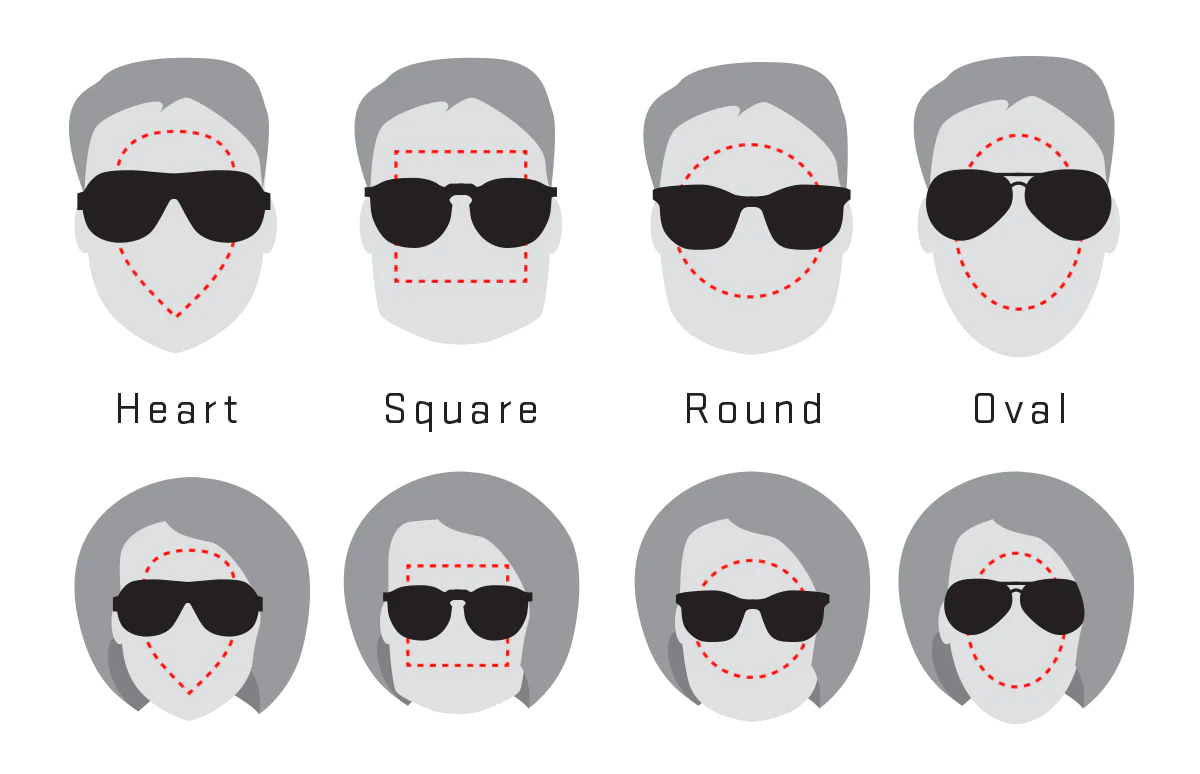
Before you start auditioning new frames, take a good look in the mirror and assess your face shape. This makes it much easier to pick styles that work with your bone structure instead of forcing it. Most people fall into one of the following face shapes and once you know yours, finding a great fit becomes less of a guessing game and much more intentional.
Round – A round face shape is more circular, especially along the jawline and around the chin. Square sunglasses like Wayfarers, cat-eye sunglasses, and other styles that add lines and angles to your face are often the best choice.
Square or rectangular – Characterized by minimal curves, and a wide, sharply angled jawline, a square face shape is best suited by sunglasses that don a few curves. Round styles and aviators are a couple of classic, well-suited choices.
Heart-shaped – If you have a heart face shape, you’ll want a pair of sunglasses that offers a similar shape. That means styles that have wide, pronounced tops and narrow bottoms.
Oval or oblong – An oval face shape is typically longer than it is wide, with a rounded chin and jawline. That makes it suitable for a wide range of styles of sunglasses, from clubmasters to oversized round or circular frames.
Triangle – If you have a large, wide jaw but small cheekbones and a narrow forehead, you have a triangle-shaped face. Opt for sunglasses that add width and volume around your eyes, like chunky D frames or large, round styles.
Diamond – The most prominent features of diamond-shaped faces are their sharp chins and wide cheekbones. This makes them amenable to both square and round-style sunglasses. From oversized circulars and aviators to rectangular and retro square styles, you have your pick.
UV Coverage. Yes Please!
Fit actually matters quite a bit when it comes to UV protection. Sunglasses that sit too far down your nose or gap at the sides allow UV light to sneak in, reducing overall protection no matter how good the lenses may be.
And while we’re on the subject, yes, your sunglasses should be protecting your eyes and the skin around them from UV rays! If they aren’t, they are seriously slacking.
Polarized lenses help cut glare in bright environments like water, snow, or pavement, making them pretty much a necessity for outdoor activities. The right pair of sunglasses can also protect your eyes from UV-related concerns like:
- Cataracts
- Macular degeneration
- Corneal sunburn
- Pterygium (a type of conjunctiva)
When you’re trying on shades, be sure to pick ones that:
Offer Protective Lenses – Most sunglasses will have a sticker or tag that tells you the amount of UV protection they offer. If your sunglasses don’t offer 100% UV protection or UV 400 protection, consider searching for another pair that does.
Provide Light Reduction – All sunglasses have a certain level of light reduction, indicated by four categories. You probably don’t need to go above category three for general daily use. Higher categories are usually meant for special activities and could actually impair your vision if conditions don’t necessitate them.
Reduce Glare – Opt for a polarized vs. non polarized pair when you know you’ll be in settings where relief from the sun and its reflection off surfaces is difficult to find, like at the beach, pool, or participating in winter activities like skiing.
If you find a pair you love but the UV coverage isn’t up to par, upgrading the lenses is an easy fix that can get you the protection you need.
The Bigger the Better
When you’re shopping for sunglasses, go big or go home. Sure, you might associate oversized shades with conspicuous avant-garde fashion or self-obsessed movie stars. But reaching for big opticals is far more than a fashion choice.
Simply put, larger shades cover more of your face, meaning the UV protection offered by the lenses is more widespread. For that reason, if protection is your priority, you should avoid styles that skimp on coverage. Instead of small circulars or narrow square styles, go for:
- Aviators
- Butterfly frames
- Large round or circular styles
- Wayfarers
The Long-Term Win
When you find sunglasses that look good and actually fit, you tend to keep them. They’re comfortable, protect better, and become a part of your daily routine instead of something you tolerate.
A proper fit also helps extend the life of your sunglasses. And when the lenses scratch or coating wears down, replacing lenses and keeping the frames is super easy. Fresh lenses restore clarity and visual comfort without having to hunt down that perfect fit all over again.
Plus, the process is incredibly simple. Revant has more than 10,000 styles of replacement lenses across 100’s of brands and frame styles. Protect your eyes from UV rays and upgrade to polarized for a fraction of the price of new frames.
Frequently Asked Questions
How should sunglasses fit on your nose?
They should sit securely without pinching, slipping, and/or leaving deep marks after just a short period.
Should sunglasses touch your cheeks?
No. If they do, the fit or size is wrong.
How tight should sunglasses be on your temples?
Secure enough to stay put, but loose enough to forget they are there.
Why do my sunglasses leave marks?
Marks usually mean pressure is not being distributed evenly. Either the bridge size is off, or the frame shape is not a great match for your face shape.
How do I know my sunglasses size?
Check the numbers inside your frames and compare them to your facial width. Our measurement guide makes it easy.